



Every scroll through your timeline is a battle for your attention—and your political agency.
In Nigeria’s hyper-connected digital space, coordinated disinformation, partisan propaganda, and outrage-driven algorithms rarely happen by accident. When the public is locked in heated debates over doctored quotes, recycled crisis videos, or fabricated ethno-religious threats, something vital gets pushed off the front page: substantive governance.
Outrage is a distraction. While citizens fight phantom battles online, real issues—budget implementation, healthcare funding, infrastructure delivery, and economic policy—escape the scrutiny they deserve.
Protecting our democracy requires more than just showing up on election day. It demands cognitive resilience and democratic intelligence: the everyday ability to filter noise, reject manipulation, and hold leaders accountable using verifiable facts.
How Information Manipulation Works
Before you can outsmart a trap, you have to see how it is built:
- The Outrage Economy: Social media algorithms reward emotion, not accuracy. Content that triggers anger, fear, or tribal loyalty spreads faster, trapping users inside echo chambers where existing biases are constantly reinforced.
- Weaponized Division: Bad-faith actors routinely exploit Nigeria’s ethnic and religious fault lines to fracture public solidarity. A united citizenry demands accountability; a divided citizenry blames its neighbors.
- Flooding the Zone: When a major policy failure or corruption scandal surfaces, coordinated networks often flood timelines with sensational gossip or competing narratives to exhaust the public’s attention span.
4 Habits to Build Cognitive Resilience
Developing democratic intelligence doesn't require a degree in journalism—just a deliberate pause before you react, share, or argue.
1. Audit Your Emotional Trigger. When a headline or WhatsApp broadcast makes your blood boil or confirms your worst fears about another group, stop. Manipulation relies on bypassing your critical thinking through immediate emotional arousal. Ask yourself: Who benefits if I get angry about this right now?
2. Trace the Claim to Primary Governance Data. Never rely on a screenshot or an anonymous blog post when official records exist. Cross-check viral claims against credible Nigerian fact-checking platforms (such as Dubawa, Africa Check, or FactCheckHub) and open-data portals like BudgIT or the National Bureau of Statistics (NBS). If a politician claims a project is completed, look for the budget line item and physical verification.
3. Inspect the Context, Not Just the Content. Many viral clips in Nigeria are real videos attached to false locations or timelines—such as a five-year-old clash repackaged as breaking news. Use reverse image searches (like Google Lens) and check dates, uniforms, or weather conditions before believing a post is happening today.
4. Follow the Policy, Not the Personality. State propaganda thrives on hero-worship and scapegoating. Shift your focus from what political figures say on podiums to what the data shows on the ground: inflation rates, debt servicing, primary school enrollment, and local government allocations.
From Fact-Checking to Evidence-Based Advocacy
Knowing the truth is only half the battle; using it is what strengthens democracy. When citizens ground their civic engagement in verified data rather than viral rumors, the conversation changes. Leaders can no longer hide behind ethnic sentiment or media spin when communities ask specific, evidence-backed questions about public funds and service delivery.
The next time a sensational post hits your feed, resist the urge to hit "forward." Verify it, share the facts, and keep your eyes on the governance that actually shapes your daily life.
Democracy doesn't survive on noise—it survives on an informed, unshakeable public. Let's have your thoughts

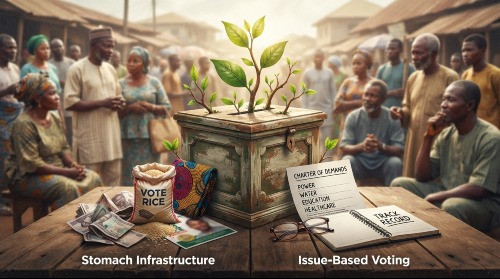
Every four years, the Nigerian political theatre stages the same predictable drama. Months before an election, politicians who were largely invisible during their tenure suddenly rediscover their grassroots. They appear at town hall meetings bearing bags of rice, customized Ankara wrappers, cartons of noodles, and crisp naira notes. In the parlance of Nigerian politics, this is "stomach infrastructure"—the art of trading immediate, consumable relief for four years of unchecked power.
When the ballots are cast and the inevitable complaints about bad roads, epileptic power, and unequipped primary health centres resume, Nigerians habitually blame the political class. We lament their greed and lack of vision. Yet, if we are honest with ourselves, a market cannot thrive without willing buyers. Vote-buying, ethnic mobilization, and transactional politics persist in Nigeria because we have normalized a culture where public office is viewed as a personal ATM rather than a vehicle for public goods.
As the Yoruba proverb warns, ẹni tí ó bá jẹ àkàrà àná kò ní rí àkàrà òní jẹ—anyone who consumes tomorrow’s seed today will go hungry when planting season arrives. Until we dismantle this "political merchant" mindset at the grassroots, Nigeria will remain trapped in a cycle of poor leadership selection.
To understand why "stomach infrastructure" works, we must acknowledge the harsh economic reality. When a citizen cannot afford a crate of eggs or pay a child’s school fees, a five-thousand-naira handout feels more tangible than a manifesto promising "macroeconomic stability." Similarly, when state institutions fail to protect citizens, politicians exploit ethnic and religious fault lines. They whisper that having "one of our own" in Aso Rock, the Government House, or the National Assembly is our only guarantee of survival.
However, decades of democratic experience have exposed this lie. Poverty does not recognize tribe, and bad roads do not spare any religion. Once a political merchant buys his way into office, his first priority is not governance—it is recouping his campaign "investment." Public funds meant for classrooms and clinics are diverted to settle godfathers and prepare for the next election cycle.
Rewiring this political culture requires more than INEC regulations or EFCC arrests on election day. It demands a deliberate value reorientation driven by three institutions closest to the everyday Nigerian: our community associations, our schools, and our local media.
First, town unions, market associations, and religious bodies must stop acting as clearinghouses for political patronage. Across the country, it is common for community leaders to confer chieftaincy titles or offer bloc endorsements to aspirants simply because they donated towards a community hall or sprayed cash at a festival. We must invert this reward system. Before any market union or town development association endorses a candidate, they should present a written charter of demands—ranging from market sanitation to rural feeder roads—and score aspirants on verifiable competence, not campaign generosity. We must also teach our communities to separate private charity from public duty. A lawmaker paying one constituent’s hospital bill is doing charity; a lawmaker ensuring the local general hospital is budgeted for and equipped is doing his job.
Second, our schools must move from teaching abstract Civics to practical political intelligence. Too many young Nigerians memorize the three arms of government to pass WAEC, yet graduate without understanding how local government allocations work or what a constituency project actually entails. Secondary schools and universities should embed basic public budget literacy into their curricula. When young voters realize that the money shared at campaign rallies is merely a fraction of the commonwealth stolen from their future, the allure of handouts will fade. Furthermore, student union elections on our campuses—which have sadly become miniature versions of national money-bag politics—must be reformed with strict spending caps and issue-based debates.
Third, local media—especially indigenous-language radio—must change how it frames politics. For millions of Nigerians from Kano to Okitipupa, morning radio programmes are the primary window into governance. Instead of giving endless airtime to political defections and praise-singing, local broadcasters and community journalists should become relentless auditors of public promises. When a politician speaks in idioms to whip up ethnic sentiment, interviewers must cut through the noise and ask hard questions about budgets, past track records, and implementation plans.
Changing a political culture built on survivalism will not happen overnight. Nigerians are resilient, pragmatic people; they will only abandon transactional politics when they see that issue-based voting delivers better schools, safer communities, and thriving businesses.
Ultimately, power in a democracy belongs to the electorate, not the highest bidder. The day Nigerians begin to look at a politician sharing bags of rice and ask, "Where is the road? Where is the hospital?"—that will be the day Nigeria's true democratic transformation begins.
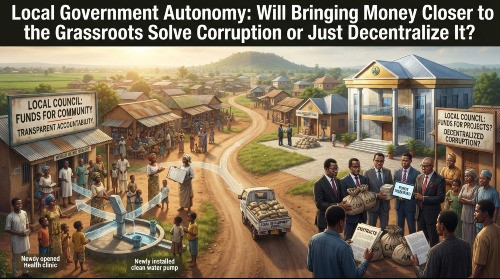
The Debate: With local governments gaining financial autonomy, funds will flow directly to chairmen and councilors. Without strong local watchdogs, are ordinary citizens literate and organized enough to track these funds—or are we simply creating 774 new centers of unchecked looting?
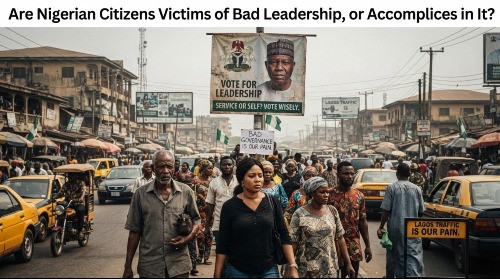
We frequently blame the political class for corruption and underdevelopment, yet communities celebrate stolen wealth, trade votes for immediate relief, and demand personal favors from officeholders. Where does leadership failure end and citizen complicity begin—and which one must change first for Nigeria to progress?



Welcome to the Nigerian BLUE CHAMBER, the Model Parliament for a New Nigeria.
Here the general public will be privileged to follow all proposed bills, progresses, deliberations, opinions and voting. Citizens will also be able to comment whenever the Parliament require the public to make inputs on any discourse.
(Setting the pace for public lawmaking and grooming new generation of leaders.)


Welcome to the Nigerian citizens general space on INEC and Electoral issues and developments. Express, report or discuss your issues and findings here.

"The greatness of a community is most accurately measured by the compassionate actions of its members" - Coretta Scott King